
Can You End Probation Early in California?
California probation can affect employment, travel, housing, professional licensing, and other parts of everyday life. Fortunately, completing every month of the original probation term is not always required.
Under California Penal Code section 1203.3, a judge may terminate probation early when the individual’s conduct and rehabilitation justify the relief and early termination would serve the interests of justice. Approval is not automatic, however. The person requesting relief must persuade the court that continued probation is no longer necessary.
What Is Early Termination of Probation?
Early termination means that the court formally ends probation before its scheduled expiration date.
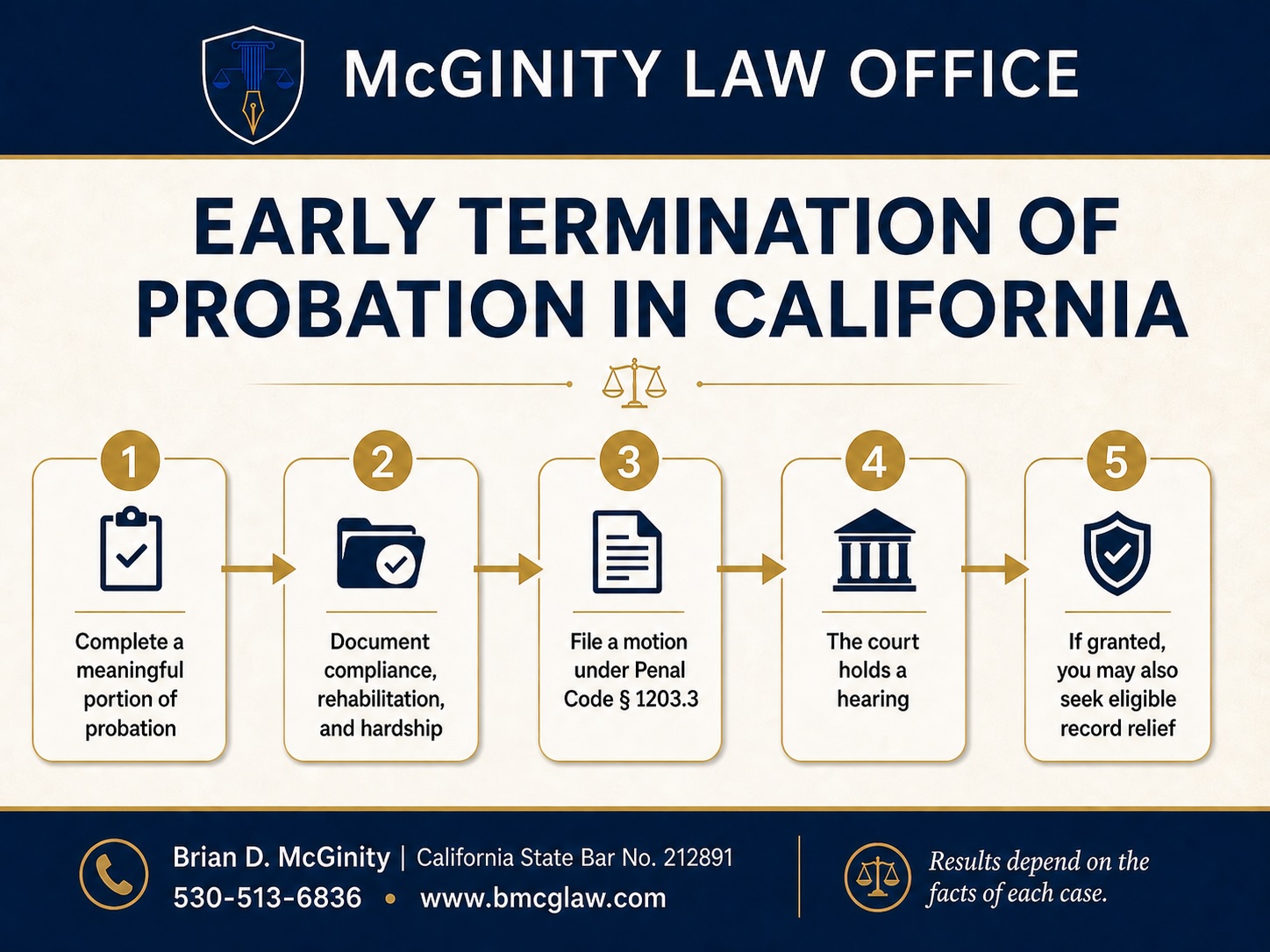
California law authorizes courts to revoke, modify, or terminate probation at any time during the probationary period. To grant early termination, the judge must find that the person’s “good conduct and reform” warrant discharge and that ending probation would serve the interests of justice.
There is no statutory rule requiring a person to complete a specific percentage of probation before filing a request. Nevertheless, the amount of probation already completed—and what the person accomplished during that time—can substantially affect the court’s decision.
Who May Be a Strong Candidate?
Every case is different, but a persuasive request commonly shows that the person has:
- Complied with the terms of probation
- Avoided new arrests and criminal charges
- Completed required counseling, treatment, education, or classes
- Finished community service or work programs
- Paid required fines and fees
- Addressed restitution obligations
- Maintained employment or pursued an education
- Demonstrated responsibility and rehabilitation
- Experienced a specific hardship because probation remains active
A request becomes more difficult when there are unresolved violations, missed programs, new criminal allegations, or incomplete court-ordered obligations.
Restitution deserves particular attention. Penal Code section 1203.3 does not generally authorize a court to reduce the amount owed merely because the probationer has performed well. The statute also permits courts to modify the time and manner of probation to measure payment of restitution. A person with an outstanding balance should therefore obtain advice about how that obligation may affect the requested relief.
What Reasons Might Support Early Termination?
Following the rules may demonstrate good conduct, but courts often want to know why probation should end ahead of schedule. A motion is usually stronger when it identifies a concrete and documented reason for relief.
Examples may include probation interfering with:
- A job offer, promotion, or professional opportunity
- Occupational or professional licensing
- Necessary work travel
- Military service
- Education or specialized training
- Housing opportunities
- Family responsibilities
- Relocation to another state
Supporting documentation can make these circumstances more persuasive. Depending on the case, useful exhibits may include an employer’s letter, proof of a denied promotion, travel requirements, school records, completion certificates, character letters, or evidence of community involvement.
How Do You Request Early Termination?
Early termination normally requires a written motion or petition in the court where the conviction occurred. The filing should explain the relevant background, document compliance, describe the applicant’s rehabilitation, and show why the interests of justice favor relief.
Penal Code section 1203.3 requires an open-court hearing before probation may be terminated early. The prosecuting attorney must receive at least two days’ written notice and an opportunity to be heard. The prosecutor must also notify a victim who previously requested updates about the case.
Local filing procedures may differ by county. A complete request may include:
- A notice of motion
- A memorandum explaining the legal and factual grounds
- A supporting declaration
- Documentary exhibits
- Proof that the required parties received notice
- A proposed order for the judge
The prosecutor, probation department, and victim may provide information or oppose the request. The judge ultimately decides whether early termination is appropriate.
What Does the Judge Consider?
Penal Code section 1203.3 does not supply a single checklist for every case. Courts may consider the entire record, including:
- The nature and seriousness of the underlying offense
- The person’s criminal history
- The amount of probation completed
- Compliance with every probation condition
- Any probation violations or new arrests
- Evidence of rehabilitation
- The status of restitution
- The position of the prosecutor and probation department
- The effect on any victim
- The hardship caused by continued probation
- Whether supervision still serves a public-safety purpose
The court has discretion. Two people with similar convictions may receive different decisions because their compliance, rehabilitation, hardships, and case histories are different.
Can You Seek Record Relief at the Same Time?
Potentially. Early termination and record relief are separate legal requests, but they may sometimes be pursued together.
Under Penal Code section 1203.4, a qualifying person who has completed probation—or has been discharged before probation ended—may ask the court to withdraw a guilty or no-contest plea, enter a not-guilty plea, and dismiss the accusation. This process is often informally called an “expungement,” although it does not erase or seal the conviction.
A section 1203.4 dismissal has important limits. Among other things:
- The conviction may still be used in a later criminal prosecution.
- The person may still have to disclose it when applying for public office, state or local licensing, or a contract with the California State Lottery.
- The dismissal does not automatically restore firearm rights.
- An unexpired criminal protective order remains enforceable.
- Certain offenses are excluded.
Eligibility must be evaluated individually. A person generally cannot receive section 1203.4 relief while serving another sentence, on probation for another offense, or charged with another crime.
Can a Felony Also Be Reduced to a Misdemeanor?
Some felony convictions—often called “wobblers”—may be eligible for reduction to a misdemeanor. Penal Code section 1203.3 recognizes that modifying a sentence can include reducing a felony to a misdemeanor.
This relief is not available for every felony and is not automatic. Eligibility depends on the offense, how it was charged and sentenced, and the procedural history of the case.
What Happens If the Court Denies the Request?
A denial does not necessarily mean probation can never be terminated early. Depending on the judge’s ruling and local practice, the person may be able to renew the request after completing additional probation, resolving outstanding requirements, or developing stronger evidence of rehabilitation and hardship.
The court may also modify probation without terminating it. Whether refiling or requesting a narrower modification makes sense depends on the reasons for the denial.
Preparing a Strong Request
A successful motion should present more than a promise to continue obeying the law. It should give the court a clear, well-supported account of rehabilitation and explain why continued supervision no longer serves a meaningful purpose.
Before filing, gather records showing:
- The probation start and scheduled completion dates
- Completion of all court-ordered programs
- Payment history for fines, fees, and restitution
- Employment or educational progress
- Community service and volunteer involvement
- Positive references
- The specific hardship caused by probation
- A record free from new violations or criminal conduct
Careful preparation can help the judge understand both what has changed since sentencing and why early termination would serve the interests of justice.
Speak With a California Criminal Defense Attorney
Early termination of probation can provide meaningful relief, but the outcome depends on the conviction, probation history, outstanding obligations, local court procedures, and available evidence of rehabilitation.
Attorney Brian D. McGinity can evaluate your circumstances, review the relevant court records, prepare and file the appropriate motion, and determine whether dismissal of the case or reduction of an eligible felony should also be requested.
Contact McGinity Law Office at 530-290-6520 or visit www.bmcglaw.com to discuss whether early termination of probation may be available in your case.
Brian D. McGinity
California State Bar No. 212891
McGinity Law Office
530-290-6520
www.bmcglaw.com
This article provides general information about California law and does not constitute legal advice. Reading this article or contacting McGinity Law Office does not, by itself, create an attorney-client relationship. Past results do not guarantee a similar outcome.
Authorities: California Penal Code § 1203.3, California Penal Code § 1203.4, and the California Courts Self-Help Guide.